


Mother-of-Pearl or Moonstone: What are the differences for your white jewelry?
Table of Contents
Introduction
In the dazzling world of jewelry, white color holds a predominant place, symbolizing purity, timeless elegance, and absolute delicacy. When one wishes to adorn their skin with a piece of jewelry with iridescent, bright, and mysterious reflections, two natural wonders immediately come to mind: mother-of-pearl and moonstone. At first glance, in a designer's illuminated display case or on an online store's screen, these two treasures can be confusing. Both offer a fascinating milky white, magnified by elusive plays of light that captivate the eye. However, the illusion stops there.
Behind this striking aesthetic resemblance lie diametrically opposed creation processes, one originating from the liquid and organic depths of our oceans, the other forged in the geological and magmatic fury of the Earth's crust. Understanding what distinguishes them is not just a matter of gemological expertise; it is also an indispensable way to choose the piece of jewelry that will perfectly match your aesthetic expectations, your consumption values, and especially your vibrational needs in lithotherapy.
This article aims to accurately dissect the origins, optical characteristics, and respective energetic powers of mother-of-pearl and moonstone, to guide you towards the most informed choice for your future luminous natural stone adornments.

Totally Opposite Origins for a Similar Sheen
The miracle of nature is such that it can produce almost identical visual renderings from ingredients and manufacturing processes that have absolutely nothing in common. This is the story of a confrontation between the marine animal kingdom and the terrestrial mineral kingdom.
The Organic and Marine Genesis of Mother-of-Pearl
Mother-of-pearl is not a stone. It belongs to the very restricted category of organic gemstones, like amber, coral, or fine pearls. It is secreted by certain mollusks, notably the famous pearl oysters, abalones, or some sea snails, to line the inside of their shells. This extraordinary biocomposite consists of a stack of microcrystals of aragonite (a form of calcium carbonate) held together by an organic protein called conchiolin. The animal produces this substance layer by layer, throughout its life, creating a smooth, incredibly resistant, and impermeable protective barrier against external parasites. It is therefore the direct result of a slow and patient biological process, bathed in the saltwater of the oceans, that gives birth to this luminous material, making mother-of-pearl a direct gift from the marine world to human craftsmanship and jewelry.
The Geological and Magmatic Formation of the Stone
At the exact opposite end of the spectrum of natural creation, moonstone is an inorganic mineral in its own right, forged by the powerful telluric forces of our planet. It belongs to the vast group of feldspars, the most abundant minerals in the Earth's crust. Its formation begins in the heart of bubbling magma pockets. When this molten rock rises to the surface and begins to cool extremely slowly, two specific components (orthoclase and albite) that were mixed at high temperatures will separate. They then crystallize into thin alternating strata, stacking one on top of the other at a microscopic level. This complex magmatic and geological process, requiring thousands, even millions of years, results in a block of raw rock that must then be patiently cut by humans to reveal the brilliance that has made it famous throughout centuries of jewelry.
Comparative Rarity and Market Value
Due to these very dissimilar origins, the value and rarity of these two materials vary considerably in the jewelry market. Mother-of-pearl is a byproduct of the pearl industry or fishing; it is therefore relatively abundant and renewable on a human timescale. This makes it an affordable material, widely used in quality fashion jewelry, watchmaking, or decorative inlay. Conversely, high-quality gem moonstone, meaning one with near-perfect translucency and an intense electric blue reflection (the most prized quality, often originating from Sri Lanka), has become an absolute geological rarity. Its mining is difficult, and its deposits are depleting. A pendant or ring made of genuine, top-quality moonstone therefore represents a significantly higher financial investment, falling fully within the realm of fine jewelry.






Visual and Optical Peculiarities
While, from a distance, both materials give off a luminous white softness, an attentive eye will quickly discover that the way they interact with light is fundamentally distinct, revealing two magnificent physical phenomena.
The Multicolored Iridescence of Shells
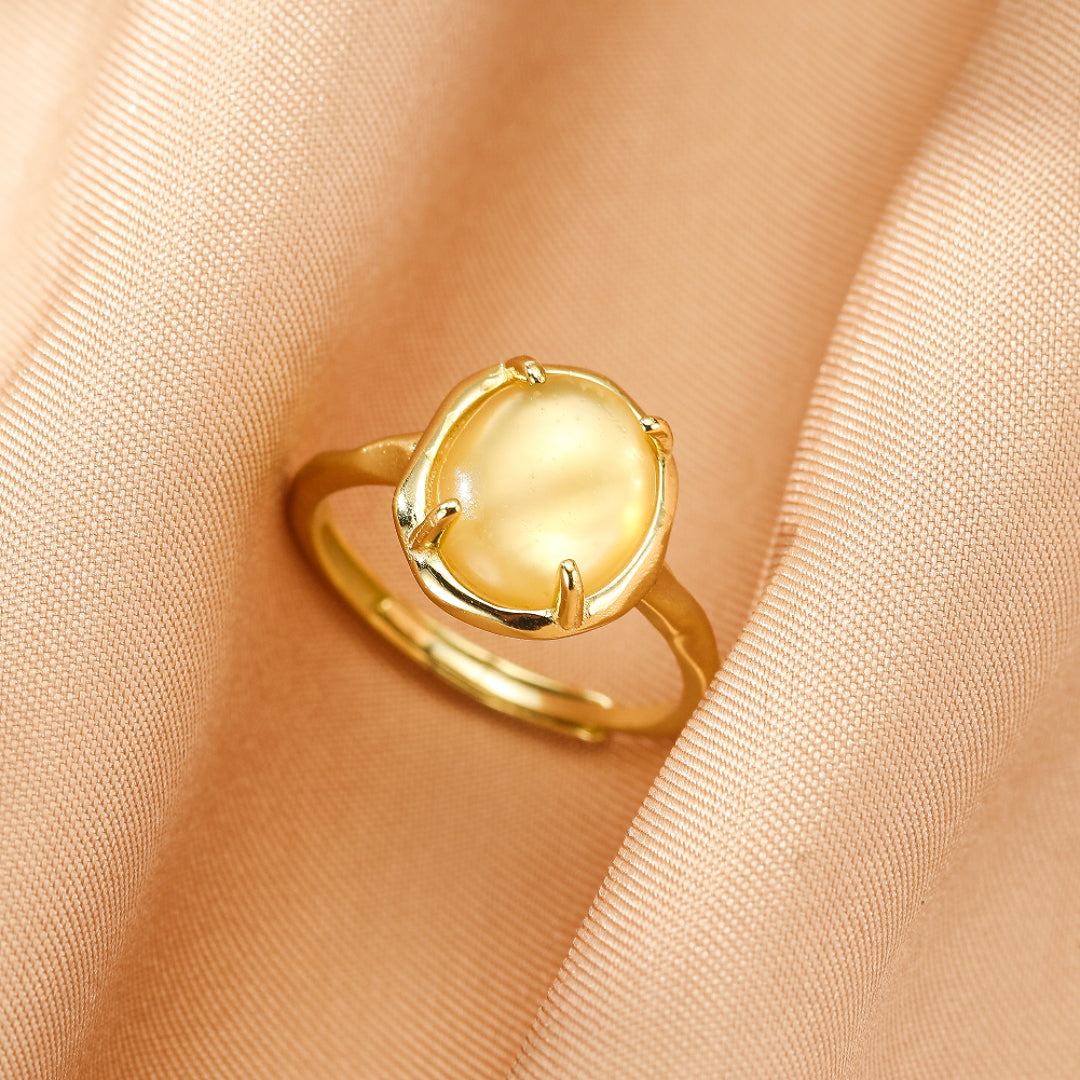
The brilliance of mother-of-pearl has a precise scientific name: iridescence. When light strikes the complex surface of the shell, it bounces off the tiny aragonite "tiles". This reflection of light creates luminous interferences that break down the solar spectrum. The visual result is a surface that appears painted with changing colors (pink, green, blue, pastel yellow) depending on the angle from which it is viewed, similar to the phenomenon observed on an oil slick or a soap bubble. The mother-of-pearl reflection is very superficial and visually "dry", but it is extraordinarily rich in small touches of metallic and joyful colors related to iridescence.
The Phenomenon of Adularescence Specific to Feldspar
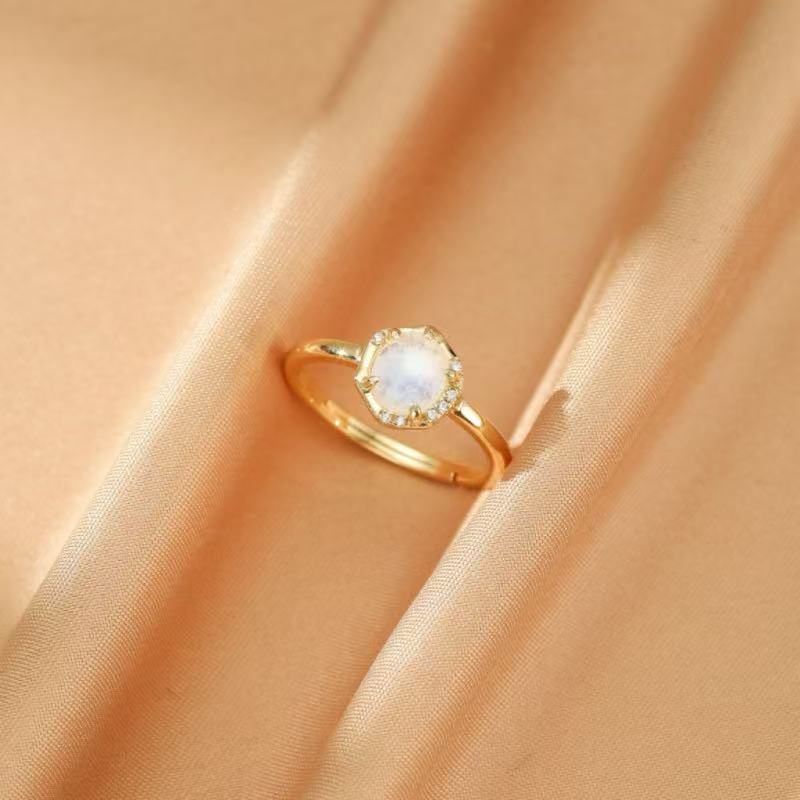
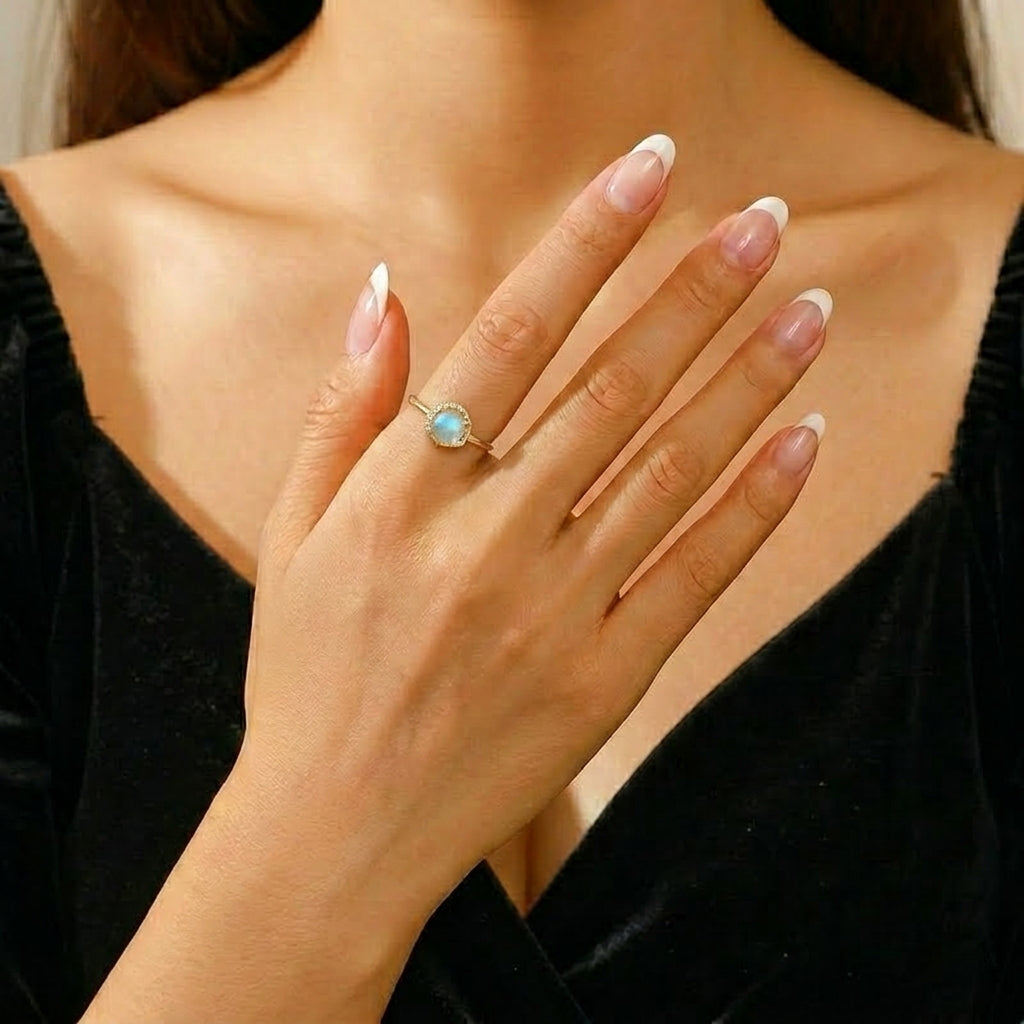
Moonstone, on the other hand, exhibits no multicolored iridescence. Its magic relies on a rare optical phenomenon called adularescence. In this case, light does not simply bounce off the surface; it literally penetrates inside the gem. By striking the alternating geological strata of orthoclase and albite, light is diffracted and dispersed within the very heart of the stone. This creates a sheen, usually white or a ghostly blue, that appears to float, glide, or undulate beneath the curved surface of the stone with movement. The effect of this adularescence is that of a luminous mist trapped within the crystal, a cold and dreamy glow that gives the impression of an elusive aquatic depth.
How to Differentiate Reflections with the Naked Eye
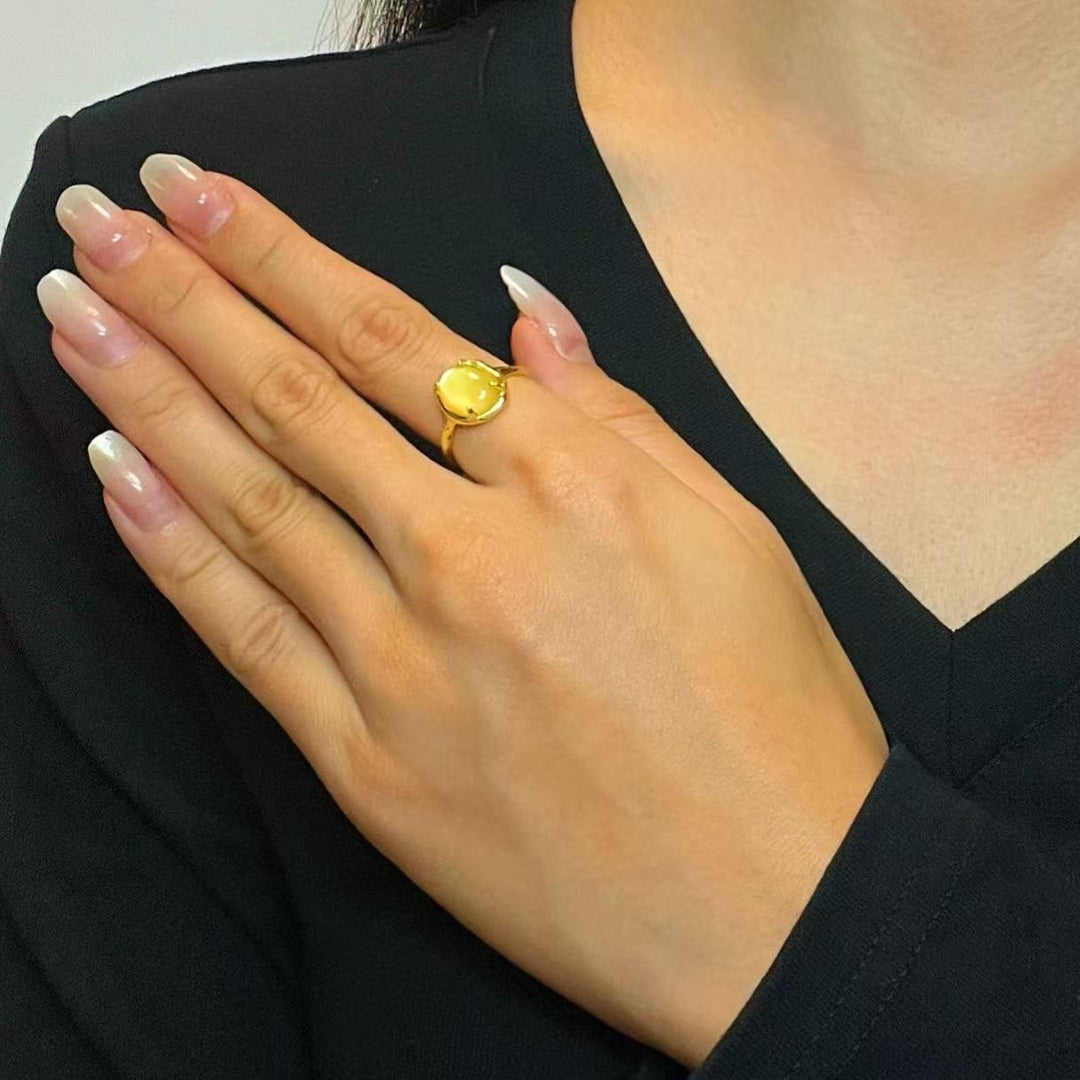
Differentiation is easy when you know the key. If the jewelry shows "rainbow" type reflections with hints of pink, green, and golden reflections very close to the outer surface, you are undeniably looking at mother-of-pearl. Furthermore, mother-of-pearl is often cut into thin slices or flat discs, not allowing for very domed shapes. If, on the contrary, the material is thick, milky, cut into a large rounded dome (cabochon), and displays only a single floating reflection (either totally white or a fascinating electric blue) that moves inside the stone without any other parasitic color, then it is indeed a true moonstone.
Energetic Divergences in Lithotherapy
Beyond appearance, it is on the level of vibrational energies that these two wonders diverge categorically. Their origins dictate their virtues, offering enthusiasts of lithotherapy two tools with distinct therapeutic functions among natural stones.

The Maternal and Protective Gentleness of the Ocean
Mother-of-pearl carries within it the entire memory of the ocean, a purifying element and the original cradle of life on Earth. Its energy is that of the protective matrix: it is maternal, enveloping, and extremely reassuring. In lithotherapy, mother-of-pearl is used to soothe anxieties, soften character, and mitigate mood swings. It is the ideal companion for sensitive skins and raw souls, acting as a soothing balm on emotional wounds related to childhood or emotional security. It promotes charm, gentle contact, and peaceful communication, without requiring heavy introspection from the user.
Spiritual Connection and Lunar Intuition
Moonstone operates on a much higher and more mystical vibrational frequency. Associated with the third eye chakra and the crown chakra, it is not just soothing; it is revelatory. It is the supreme stone of intuition, clairvoyance, and connection with invisible dimensions. It promotes premonitory dreams, accompanies spiritual awakening, and balances Yin and Yang energies. If mother-of-pearl comforts like an earthly mother, moonstone guides like a cosmic force. It is also the undisputed ally of women on a biological level, helping to harmonize hormonal cycles and energetically supporting fertility.
Choosing Your Jewelry According to Your Vibrational Needs
The final choice will intimately depend on your current psychic needs. If you are going through a period of nervous fatigue, need softness, immediate comfort, to feel protected in a secure cocoon while wearing luminous and joyful jewelry, mother-of-pearl will be your best choice. If, on the other hand, you are engaged in a quest for personal development, wish to develop your sixth sense, understand the mysteries of your unconscious through your dreams, or accompany the cyclical changes in your life as a woman with a gem of great spiritual power, then the dreamy nobility of moonstone will be an absolute obvious choice.
Conclusion
Mother-of-pearl and moonstone are two sides of the same aesthetic whiteness coin, both offering the opportunity to carry light close to the skin. One testifies to the biological ingenuity and resilience of the marine world with its joyful iridescent hues and maternal embrace. The other recounts the slow magic of geological crystallization with its ghostly glow linked to adularescence, its electric blue, and its cosmic and intuitive wisdom dear to lithotherapy. Confusing these two materials is a common mistake, but knowing how to differentiate them significantly enriches one's relationship with jewelry. By understanding their distinct origins and properties, you are now equipped to make a choice that will no longer be guided merely by visual chance, but by a desire to align your natural stone adornment with your deep aspirations and your own vibrational frequency.
Genuine Moonstone Bracelet: How to Recognize a Real Stone?
Is it true that moonstone is more fragile than mother-of-pearl?
No, mother-of-pearl is made of limestone and is relatively soft (3 to 4 on the Mohs scale), while the lunar mineral is a more resistant feldspar (6 to 6.5).
Can a mother-of-pearl jewelry be combined with a moonstone jewelry?
Absolutely, the combination of the maternal energy of the sea with the spiritual energy of the mineral creates an aura of extreme softness, peace, and femininity.
Does water damage either of these two materials?
Moonstone tolerates fresh water without problems for its purification, but mother-of-pearl, although born in water, can tarnish with chemicals and the acidity of sweat.
Why is mother-of-pearl often much cheaper?
Because it is harvested in large quantities through aquaculture and reproduces biologically, unlike moonstone's geological veins which are rare and exhaustible.
Do both materials soften one's character?
Yes, both soothe anger and stress, but mother-of-pearl acts as a comforting surface cocoon, while the lunar gem works on deep emotional balance.
Which one is better for stimulating intuition and clairvoyance?
It is undeniably moonstone; its strong connection to the third eye chakra makes it a tool for clairvoyance, whereas mother-of-pearl has no extrasensory influence.
How to clean a pendant that contains mother-of-pearl?
A simple, very soft cloth soaked in a drop of olive oil is enough to restore its luster; never use acid, vinegar, or silverware cleaning products for your jewelry.
Are there multi-colored moonstones like mother-of-pearl?
What is often called "rainbow moonstone" in trade is actually white labradorite, which exhibits reflections of several colors, unlike genuine orthoclase.
Can I offer mother-of-pearl to a pregnant woman instead of moonstone?
Yes, it's an excellent idea; mother-of-pearl will bring gentle maternal energy and physical protection, while moonstone will help her with the hormonal and spiritual aspects of pregnancy.
Which of these two materials weighs the most?
Since the mineral is pure rock, an orthoclase cabochon will always be significantly denser and heavier in the hand than a seashell piece of equivalent size.
Read more

Given the popularity of moonstone, glass or plastic imitations are flooding the market. Protect your investment by learning to recognize true adularescence, test the gem's temperature, and identify...
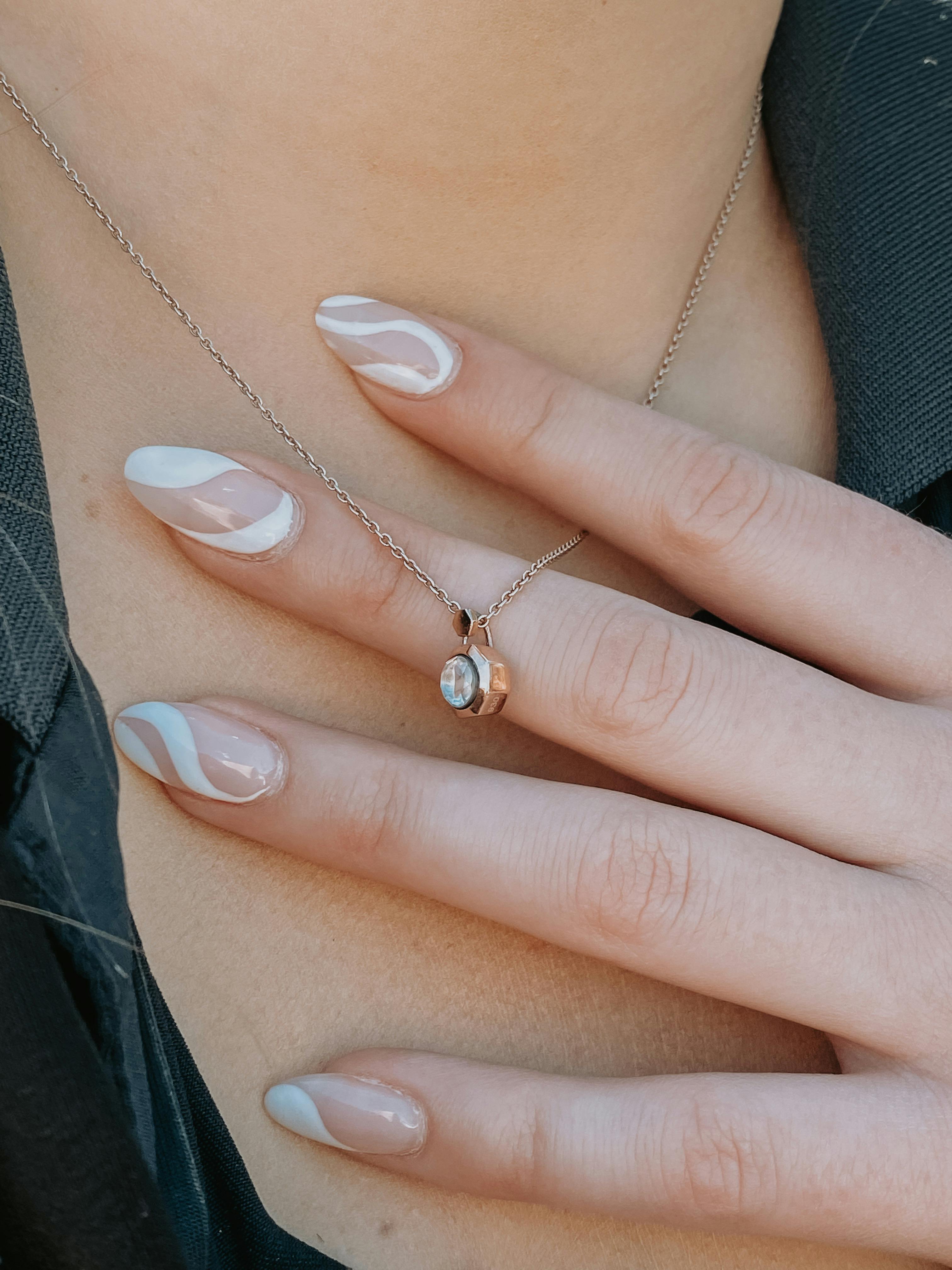
Since ancient times, moonstone has been the ultimate symbol of femininity and motherhood. This guide explores how this exceptional mineral supports women, soothes premenstrual tension, regulates cy...
Leave a comment
This site is protected by hCaptcha and the hCaptcha Privacy Policy and Terms of Service apply.