


All About Dreamcatchers: History, Meaning, Use, Making
Originating from Native American culture, which stretched from Canadian to North American regions, the dreamcatcher is becoming increasingly popular today in Europe and the United States. Some use it to decorate their bedrooms, adding a zen style, while others use it to improve sleep and achieve restorative sleep.
In this article, you will learn all about dreamcatchers: their history across different cultures, their symbolic meaning, their current use, and manufacturing methods if you want to make a dreamcatcher yourself!
What is a dreamcatcher?
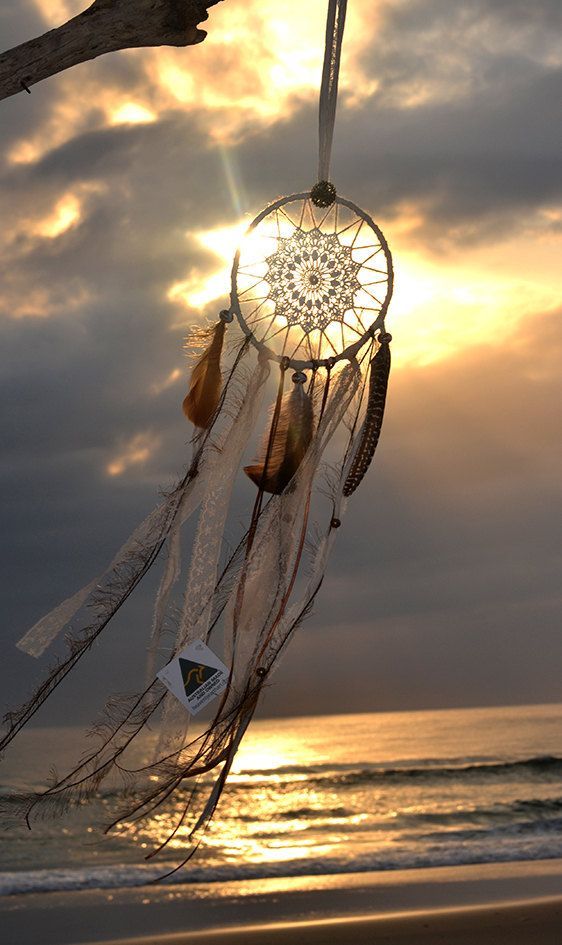
Traditionally, a dreamcatcher is a handcrafted object made up of a hoop, a woven web inside the hoop, and various decorative items such as feathers, lace, ribbons, or beads, etc. Today, more and more manufacturers have designed other shapes such as triangles, squares, or even heart shapes.
As its name suggests, a dreamcatcher is an object that catches dreams. It protects the sleep of its owner by burning bad dreams at the first light of day. This is why many people hang dreamcatchers above newborns' cribs or children's beds. Over the years, adults have also decided to protect their sleep by hanging dreamcatchers in their bedrooms.
Nevertheless, it should be noted that a dreamcatcher does not interpret your dreams. It allows you to keep the most important dreams, sometimes revealing ones. A bad dream does not necessarily mean a nightmare – a nightmare can contain important messages and is allowed to pass through by a dreamcatcher – a bad dream rather means a dream without a useful message for you.
What is the history of the dreamcatcher?
The dreamcatcher originates from Native American culture. The most well-known tribe for making dreamcatchers is the Ojibwe tribe. However, the dreamcatcher does not exclusively belong to the Ojibwe. Here we present three legends surrounding the origin of the dreamcatcher.

The legend of the spider
For many cultures around the world, spiders are feared and frightening insects. However, for the Ojibwe tribe, they actually represented a symbol of protection and comfort.
An old Ojibwe legend tells that at the beginning of the world, a mystical woman was nicknamed "the spider woman". She ensured the spiritual protection of the tribe, and especially of young children, babies, and newborns.
The Ojibwe tribe continued to grow and spread across the territory over the years. It then became difficult for the spider woman to continue to ensure the protection of all tribe members, who had migrated to distant lands. The idea then came to her to create the Native American dreamcatcher. Following her example, mothers and grandmothers in turn recreated it with the aim of protecting their children and family, from a distance.
The legend of the hunter
A hunter had left his family for several days in search of food. After several days of walking, exhausted, he encountered a beast that greatly frightened him. Haunted by the vision of this creature, he was unable to find peaceful sleep.
One day, tired of his sleepless nights, the man fell asleep in the middle of the forest. When he woke up, he was very surprised not to have had any bad dreams. He noticed a spiderweb nearby where he had fallen asleep. He then deduced that this spiderweb was what protected him from his bad dreams.
When he returned to his tribe, the convinced man decided to make an object in the shape of a spiderweb which he hung in his hut. The tribe did the same and began to weave webs to catch bad dreams. They adorned the web with beads to symbolize the morning dew that had settled on the spiderweb.
The legend of the Great Spirit
In the Lakota tribe in America, the people were haunted by bad dreams. Children were frightened and tired. Faced with this phenomenon, the village chief decided to summon all the wise men of the tribe.
It was then that a great Shaman went to isolate himself in the forest to invoke the spirits for a solution. During his meditation, he met the Great Spirit of the forest. This appeared in the form of a spider and explained to the sage that he needed a filter to keep positive energies.
Back in the village, the Sage told the rest of the tribe about his encounter with the Great Spirit, convincing them to make an object in the shape of a spiderweb. The first dreamcatchers were created to filter bad dreams and to allow good energies to pass through.
What is the meaning of a dreamcatcher?
According to different cultures, the meaning of a dreamcatcher is simple: it is an object that protects its owner against evil spirits and attracts good spirits during sleep. Evil spirits create worries and troubles for no reason, while good spirits transmit their teachings through visions in dreams. A dreamcatcher only retains important dreams that truly have meaning for the dreamer.
A typical dreamcatcher is composed of four main parts – the hoop, the web, the bead, and the feather – each carrying an important meaning. This is why in the making of dreamcatchers, the elements have been carefully chosen, both in terms of material and shape.

The hoop
It symbolizes eternal life and the cycle of life.
The dreamcatcher is often in the shape of a circle. The circle represents the cycle of life. This includes all elements around human life such as earth, moon, sun, water, fire, the cycle of day and night, but also seasonal variations. The hoop also represents the sun which brings positive forces.
The diameter of the circle can be different, so dreamcatchers of several different sizes are found. There is no effect between size and the ability to catch bad dreams; it is mainly a matter of preference.
The web
It is used to catch bad dreams.
The traditional weaving of dreamcatchers is based on the spider's web. But the number of contacts with the sage circle represents different meanings, which are distributed as follows:
- 7 anchoring points: the 7 foundations of Native American culture.
- 8 anchoring points: the 8 spider legs
- 13 anchoring points: the 13 phases of the moon
The hole in the center of the dreamcatcher is the passage for good dreams. While the web serves to filter out evil spirits or negative energies, the web also collects the first rays of sun, which are notably supposed to bring peace and serenity during the day.
The central bead
It is the symbol of protective spirits.
In some dreamcatcher models, a bead is found in the center of the web. For Native American tribes, especially the Lakota, this bead represents the spider, the Great Spirit. Among the Ojibwe, the central bead represents the protective Spider Woman for children. These are notably the protective spirits that guide the tribes and protect them during their sleep.
The feathers
They serve to bring good dreams into your mind.
Feathers are a symbol of lightness, softness, but also of air. It is the first foundation of Native American culture. Feathers are chosen because they allow dreams to glide down to the owner of the object. Furthermore, feathers also create a link between humans and the Protective Great Spirit.
How to use a dreamcatcher?
Today, dreamcatchers have several uses: some people use them as a way to capture bad dreams. To work, this object must be placed above the bed, oriented to catch the first light of day to destroy the dreams that have been captured. Many have also chosen to hang it above a baby's crib.

Other people, however, use this object as zen decoration. It can be used as a wall ornament in a bedroom to give the room a bohemian feel. The decorative models are very varied and it is possible to find them with shells, pom-poms, ribbons, etc. These decorative objects can be hung anywhere in your house, and even in your garden.
Dreamcatchers come in various sizes today, so much so that some use them to make jewelry. Thus, it is possible to find them in the form of earrings or pendants.
How to make a dreamcatcher?
If you don't want to buy a dreamcatcher, it's entirely possible to make one yourself. According to Native American legends, a self-made dreamcatcher has more powerful protective effects.
Making a dreamcatcher can be simple in 3 steps:
- Wrap a hoop with cotton string
- Weave the web symmetrically
- Attach feathers and shells
More concretely, you would need the following materials:
- A wooden or metal hoop: choose the size according to your preference
- String: cotton thread, linen, or even colored threads
- Feathers: synthetic from a store or natural from the forest
- Decorations: such as colorful beads or shells
- Ribbons or cords
- Glue

Once all your materials are ready, we can begin the creation.
- Wrap the yarn around the hoop until it is completely covered. Secure with a knot.
- Take a length of colored string, tie a knot around your hoop at regular intervals, then stretch the string a few meters towards the center and make a loop. Continue to make regularly spaced loops until you have completed the entire circle.
- Repeat this process with a second length of string…
- ... And again with a third.
- Now, tie a length of string to a feather and attach it with a knot to the bottom of your hoop.
- Then, add some decorations. We glued mini pom-poms and a glitter star.
- The last step is to tie a loop of string at the top to hang your dreamcatcher.
Making a dreamcatcher can be relaxing, even therapeutic, as it allows you to focus and re-center yourself. Try making this object, which is both decorative and spiritual, with your loved ones or children now!
Read more
The Feng Shui Tree of Life is an interior decoration that has several benefits. Thanks to the meaning of this tree, using this decoration purifies the interior. It brings positive energy for a life...
The evil eye is often associated with jealousy or negative emotions. Here are 5 methods to protect yourself and remove the evil eye.
Leave a comment
This site is protected by hCaptcha and the hCaptcha Privacy Policy and Terms of Service apply.