Tap a dot to jump to that region.
Brazil
Minas Gerais · Rio Grande do Sul
Amethyst · Agate · Aquamarine · Rose quartz · Carnelian
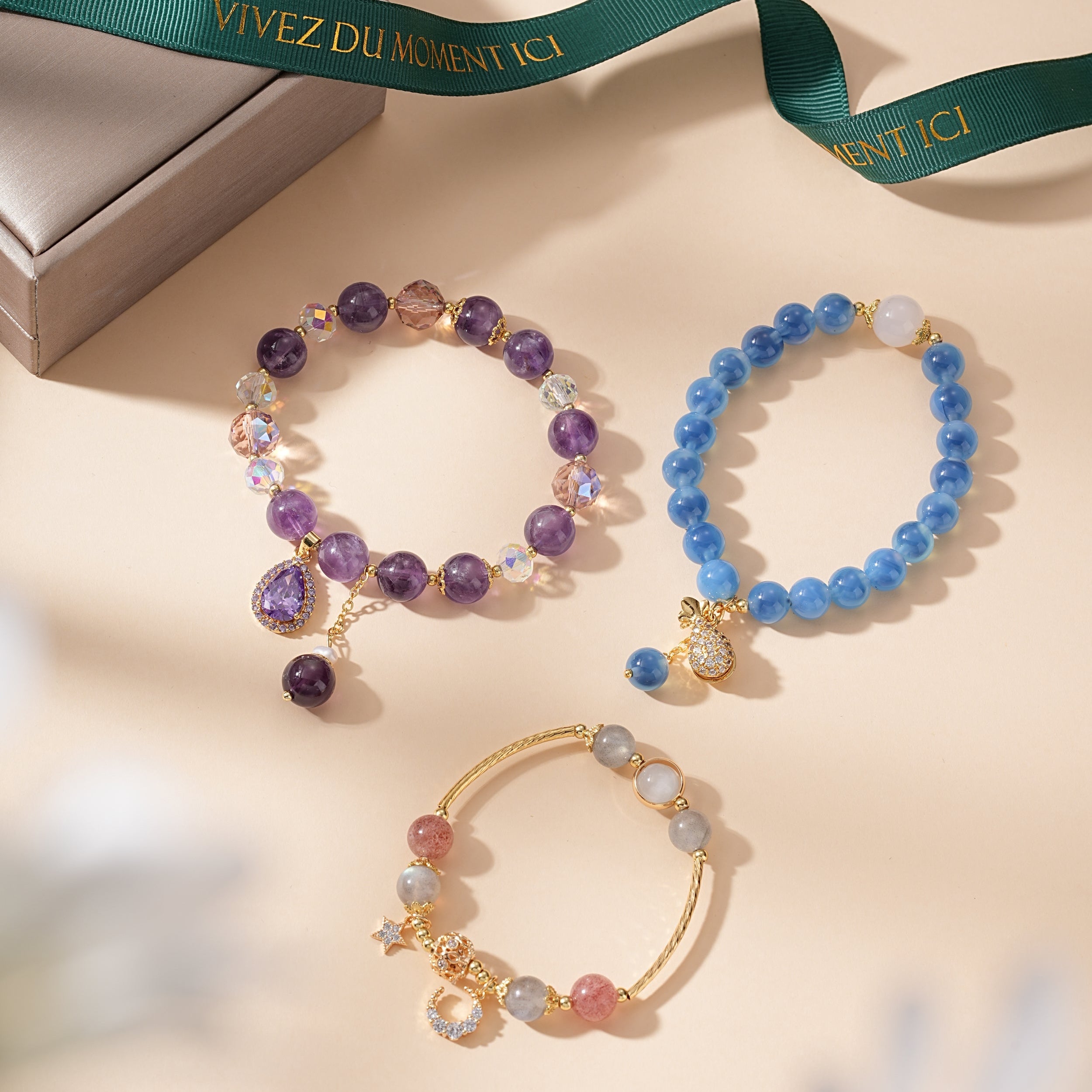
Amethysts grow inside geodes in basalt flows: gas bubbles trapped in cooling lava, later lined with violet quartz by very cold groundwater — millions of years after the volcano went quiet.
Uruguay
Artigas
Amethyst · Agate
The same basalt plateau as southern Brazil, just across the border. Agates form concentric bands there, each band recording a change in the fluid that laid it down.
The Andes
Catamarca, Argentina · Coquimbo, Chile
Rhodochrosite · Lapis lazuli
Rhodochrosite from Capillitas builds up as banded pink stalactites in hydrothermal veins. Chilean lapis is paler and more veined with white than Afghan lapis: we own that difference rather than dyeing it away.
Mexico
Jalisco · Hidalgo
Obsidian
Obsidian is not a mineral, it is a glass. Silica-rich lava cooled too fast for anything to crystallise — which is why it breaks with that smooth, razor-sharp edge.
Arizona, United States
Peridot Mesa, San Carlos
Peridot
Olivine from the Earth's mantle, carried up as fragments in basalt lava. Mining there is reserved for members of the San Carlos Apache tribe, on their own land, entirely by hand.
Canada
British Columbia
Nephrite jade
Nephrite is a microscopic felt of interlocking fibres. It is that tangle — not its hardness — that makes it almost impossible to break.
India
Gujarat · Karnataka · Rajasthan
Aventurine · Agate · Carnelian · Jasper · Garnet
Aventurine is not a mineral but a rock: a quartzite whose glittering green comes from inclusions of fuchsite, a mica coloured by chromium.
Sri Lanka
Meetiyagoda, Galle District
Moonstone · Garnet
In moonstone, two feldspars separated into alternating layers during a very slow cooling. Those layers scatter light — that is where the drifting blue sheen comes from.
Pakistan
Karakoram, Gilgit-Baltistan
Aquamarine
In the pegmatite pockets of the Karakoram, the last fluids of a cooling granite, loaded with beryllium, let beryl crystals grow to a rare clarity.
China
Hubei · Xinjiang
Turquoise · Nephrite jade
Turquoise only forms in arid climates, where copper-rich water percolates slowly through rocks containing phosphorus and aluminium, and precipitates in the fractures.
Indonesia
Java · volcanic belt
Lava crystal
Vesicular basalt: the cavities are magma gases, frozen in place as it rose. Basalt makes up more than 90% of the planet's volcanic rock — we don't invent a famous volcano for it.
Madagascar
Highlands · Andilamena
Amazonite · Rose quartz · Moonstone · Aquamarine
The island exposes some of the richest pegmatite fields in the world. A large share of the rose quartz and amazonite on the market comes from here — most often from small artisanal workings.
South Africa
Northern Cape, Prieska area
Tiger's eye
Quartz replaced a fibrous mineral there, fibre by fibre, inside iron formations two billion years old — keeping the original alignment. Hence the sheen that moves with the light.
Zambia
Kariba, Mapatizya
Amethyst
A darker amethyst, often edged with red, grown in quartz veins rather than geodes. Mining there is largely artisanal.
And the cutting?
A distinction that matters
A crystal is rarely cut where it is mined. The vast majority of the world's beads are shaped in India and China, whatever the origin of the rough.
That is why we speak of a mining region, never of “a crystal from India”: the two do not mean the same thing, and blurring them suits too many people.